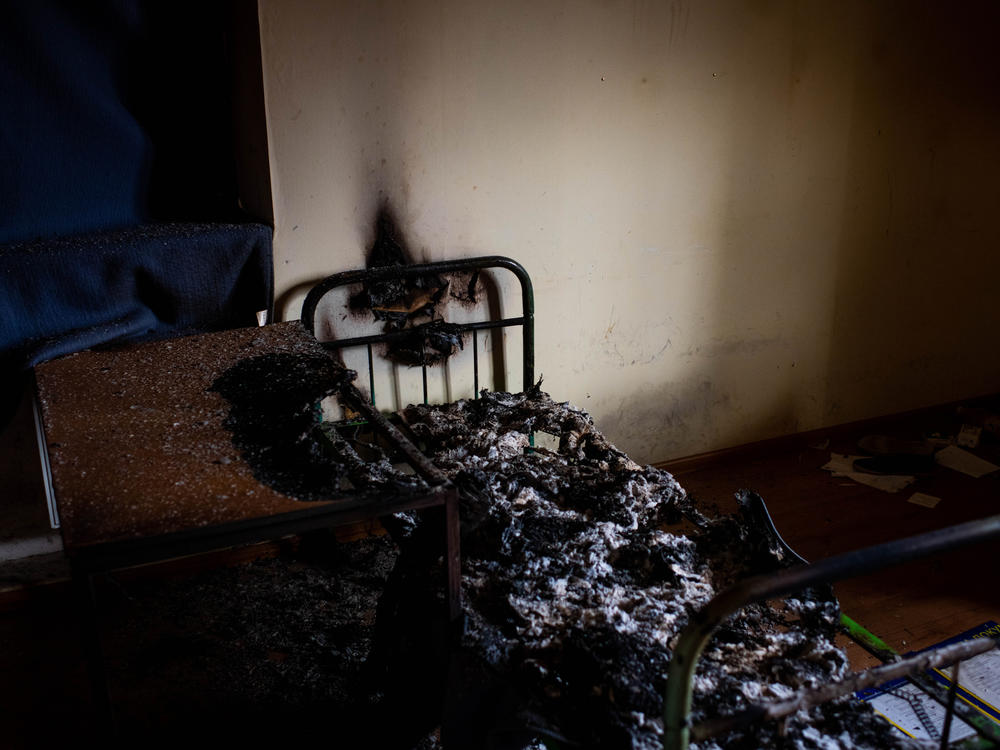
The existence of a vast concentration camp system where soldiers and civilians are currently being tortured leaves us with four options: indifference, cynicism, relativism—or documentation. Antonina Ivakhnenko co-translated into English one of the most harrowing first-hand accounts of Russia’s current detention system : ‘The Captivity’, by Valeriya Subotina. We wanted to introduce this book to our readers.
DdN – Before introducing The Captivity to our readers, could you briefly present Valeriya Subotina?
A. I – Valeriya Subotina is a journalist born in Mariupol which is now occupied by russia. She was stuck in the Azovstal during the long siege, working there and trying to show the world the horrible situation Ukrainian people got into. It was in the Azovstal when she got married, but her husband was killed in a few days. She was captured by the russian troops and stayed for a long time in captivity until she was liberated through the exchange process. She is an active participant of both the political and cultural life of Ukraine up to now.
DdN – Valeriya was detained in the penal colony of Olenivka, in the Donetsk region, before being transferred to Taganrog, widely regarded as one of the most brutal detention facilities currently in operation. Could you tell us more about the history of the manuscript, and how the three of you came to work together on its translation?
A.I – I had worked with Folio for many years before, and I had already had an opportunity to translate several other books published by them, both from and into Ukrainian, so the editor just asked me if I would like to translate Valeriya’s text. I agreed, as I had heard a lot about the horrible situation she had been in, and I wanted to spread the information of our struggle against russia all over the world.
Folio wanted the translation to appear as soon as possible, so it was obvious that one person could not do it well enough in such a short period of time. That is why they asked several translators to collaborate. Each of us translated some portion of the text, which they could accomplish by the deadline. Then the three parts of translation were merged and edited by one person, so that the original style was preserved.
DdN – I fully understand the urgency of publishing this testimony, as the book indeed provides crucial insights into the concentration camp system in the occupied territories and in Russia. The Captivity, it seems to me, is a story of irreconcilable opposites: torturers and prisoners, two forms of humanity locked in absolute confrontation. “It is better to be on the side of the strong, those who will win the war,” says an interrogator to Valeryia – as if the very idea of resistance meant nothing. This is probably why Valeryia remains utterly incomprehensible to them. Would you agree with this reading?
A.I – Absolutely. First of all, it is necessary to mention that russians do believe that they have never lost a single war. They think God himself leads them. They think that any struggle against them is not only in vain, but also against God’s will. Ukrainians, on the other hand, have always, throughout history, struggled for freedom, za voliu y svobodu, as we put it, no matter what. Besides, the current situation shows that “the strong” may be outwitted, and it is not the physical strength that really matters, but the intellect. There are many strong beasts in the world, much stronger than humans, but still it is humans who rule the world due to our intellect. So, no war is lost until a Ukrainian is alive. For russians, it is something beyond understanding.
DdN – I do not intend to describe the acts of torture in detail here. Instead, I want to focus on the logic that underpins them. Although many prisoners die from their injuries, and even the traces of their deaths are sometimes erased through administrative concealment — a practice that strongly recalls the Nazi Nacht und Nebel policy — prisoners are generally not executed outright because they retain value, whether for future prisoner exchanges or other purposes. The objective is not, therefore, immediate execution. It is the systematic destruction of the prisoner through carefully calibrated physical and psychological violence, while keeping them alive for as long as they serve the interests of the system. Would you say that this summary accurately reflects the reality of captivity ?
A.I – Yes, the goal of this process really is to change the minds of the captives, on the one hand. On the other hand, I think the whole idea is to make POWs mistrust the world, and to make the world mistrust POWs. Because it’s quite difficult to believe that such treatment is possible nowadays, especially at the hands of representatives of a people famous for its rich culture. russians want to “kill” the captives spiritually and create the impression that nobody will believe what they are going through – and that nobody really cares about what is happening. Besides, many russians working in the camps are simply sadists, so they enjoy what they do to the captives.
DdN – Thanks to social media, people can spread the claim that Russians are fighting Nazis in Ukraine. And yet this narrative does not end online: these are the very words with which soldiers and civilians are tortured. The book’s central aim is to show how the FSB interrogates prisoners. What struck me most is that the torturers use exactly the same language as those anonymous users online—or, perhaps more accurately, that those users end up repeating the language of the torturers.
A.I – Well, to realize this as a fact, people should be willing to think, analyze, and draw conclusions based on that analysis. Unfortunately, very few people can do it and want to. “Thinking is a hard but useful process”, as one of my teachers once put it. Social media is nothing more than a medium – but nothing less than a medium, either. “He that hath ears to hear, let him hear.” (Matt. 13:9, if I am not mistaken). Lots and lots of video files showing the real situation both at the front and in the rear can be seen on Telegram, loaded by both ordinary people and military personnel. If a person does not see them, they are just not willing to see them.
Ukrainians speak a lot of the fundamentally different attitude towards POWs in russia and in Ukraine, and bring lots and lots of proof supporting their words, but I’ve got the impression that we’re just spinning our wheels… russians do not want to hear or see anything that contradicts their belief that they are carrying out a righteous war against fascism or nazism. The very last time I tried to convince a russian that she was mistaken, I got this statement as an answer: “If what you are saying were true, then I would have to admit that our troops are Nazis, not yours. And this is impossible. We’ve always spared civilians, we’ve never ever tortured anyone. It’s just impossible even to think of it. That is why your words are nothing but lies”.
I believe that is the reason why their narrative goes as it does. It’s not a question of proof for them, it’s a question of faith. putin is a new God to them, Ukraine is The Whore of Babylon, and the West in general is the “scarlet coloured beast, full of names of blasphemy, having seven heads and ten horns”. And I doubt we can somehow change this worldview, unfortunately…
DdN – We cannot change the mentality of the perpetrators but we can make sure these stories are heard. I cannot conclude this interview without thanking you for this remarkable translation. “When I was there,” Valeriya writes at the end, “I wanted someone to speak for me so much.” How do you think we can best honour this request: to speak for those who cannot speak for themselves in the penal colonies, today?
A.I – Well, it really is a problem, as only a few can speak for themselves. First of all, we should give them this opportunity: both journalists and lawyers should meet those saved from captivity, speak to them, ask them questions and hear their answers. International institutions must never give up their efforts to visit POW camps and highlight the horrible conditions there.
You know, when we see our people freed from russian captivity, they are obviously exhausted, and half-dead with hunger, and bear numerous signs of physical torture. These signs are striking, you cannot explain them by anything but torture. Just compare our soldiers returning home from captivity and russian soldiers-russian POWs returning home from Ukrainian captivity have been obviously well-fed and well-treated. So, the work should be done in several directions: testimony taken from POWs, visits to camps, broad publicity of the cases, and finally, the prosecution for those who violate international treaties and basic human rights.
Interview conducted on the 8th of July, 2026.
Photo credit : Pete Kiehart.
Subotina, Valeriya “Nava”. The Captivity. Translated from the Ukrainian by Antonina Ivakhnenko, Julia Lugovska and Ganna Krapivnyk. Kharkiv: Folio Publishing House. 252 pp. ISBN 978-617-551-937-0.



Leave a Reply