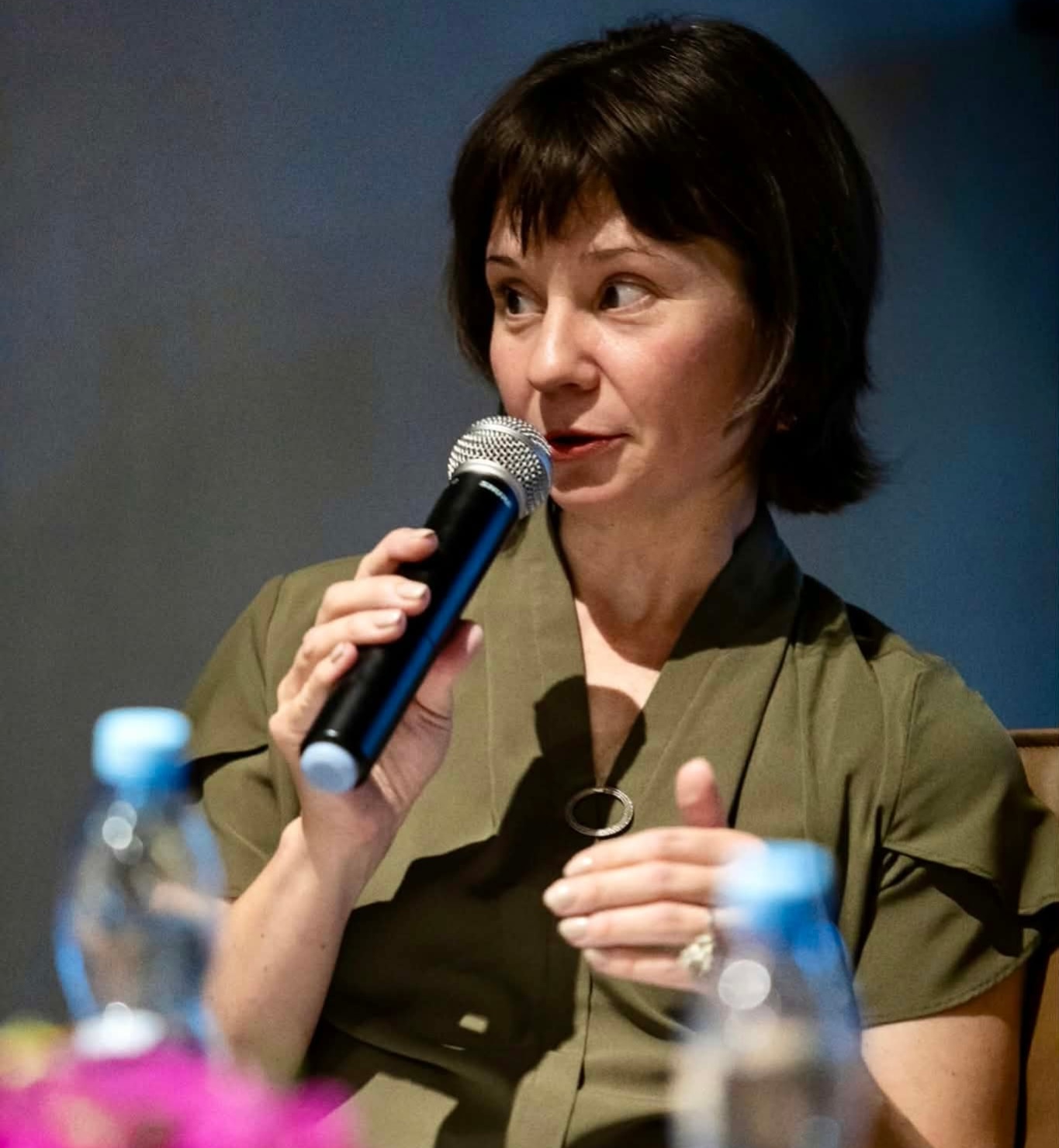
Larissa Babij is a Ukrainian-American writer, translator, and Editor-in-Chief of the London Ukrainian Review. Amid a thousand projects, she found time to sit down with us for this interview.
O.R. — Larissa, among many professional pursuits—and in your case, the phrase “among many pursuits” is not an exaggeration at all—you are the Editor-in-Chief of the London Ukrainian Review, which was founded in 2021. Could you please introduce the review to our readers and tell us more about its new issue, which will be released on the 5th of November?
L.B — Thank you, Olivia, for inviting me to talk about my many pursuits related to sharing the richness of Ukrainian culture with the English-speaking world!
First, I should say that the upcoming issue of the London Ukrainian Review on Veterans is my debut as the journal’s editor. Since 2024 I’ve had the great pleasure of working with founding editor Sasha Dovzhyk, who together with the Ukrainian Institute London launched the journal in 2021. Today the London Ukrainian Review is a regular open-access journal with two thematic issues per year published online and starting this year also in print.
Facilitating the encounter between brilliant thinkers, artists, and scholars of Ukraine (working both inside and outside the country) and a global readership, we show how Ukraine enriches international discourse, especially around issues like security, justice, and the environment. In addition to essays from leading scholars and policymakers, each issue features literature and visual artwork, demonstrating that serious thought takes various forms.
In addition to the journal’s thematic issues, we send out a monthly newsletter called LUR Culture Brief with a curated list of upcoming Ukraine-related events around the world, a book review, and a brief FPV (first-person-view) commentary from one of Ukraine’s defenders. The future of the democratic world and of Ukraine as a political nation is being decided on the front lines of its defence against Russian invasion, and it is our job to maintain a supportive connection with the people who are doing this grueling work to protect the political freedom of Ukrainians and the entire democratic world.
The next issue of the London Ukrainian Review is dedicated to Veterans. Ukraine has two million veterans today and that number will only keep growing as long as Russia continues its assault. With contributions from veterans who have defended Ukraine from Russian invasion, researchers who’ve documented Ukraine’s veterans since the 2014 Anti-Terrorist Operation (ATO) until the present, and veterans from Croatia and the US, this issue highlights the drive of many Ukrainian veterans to contribute to their society, the importance of documenting the experience of war, as well as the challenges of returning to civilian life when your entire country remains a war zone.
The issue will be presented publicly in London on 5 November with a panel discussion featuring Ukrainian veterans, an expert on veteran policy, and leaders of US- and UK-based organisations supporting veterans in Ukraine. Readers in the UK, please join us for the discussion, where you can receive a copy of the journal – hot off the press!
O.R. — Thank you for such a compelling introduction to the London Ukrainian Review! We warmly encourage our readers to join you in London on the 5th of November (see details below*). Reading your book A Kind of Refugee (published in 2024), we discover that you’ve been committed to helping combat veterans since the very beginning of the full scale invasion, especially by teaching them the Feldenkrais method. Why do you think this practice is particularly relevant for Ukrainian veterans—and also for the civilians who live with the permanent stress of war?
L.B. — That’s a big question! I began studying the Feldenkrais Method of somatic education and training to teach Awareness Through Movement classes in 2017. When Russia launched its full-scale invasion of Ukraine I had a regular practice teaching small groups of people in Kyiv and online how to increase their awareness of what they are doing and feeling in movement, helping them learn how to do what they want with less effort and more pleasure.
The Feldenkrais Method is a learning practice, which addresses the entire person as a complete, integrated whole (body, mind, past experience, habits, living in a physical and social environment) and engages the capacity of the human nervous system to build new neural pathways (i.e., to learn and to change) throughout a person’s entire life.
This is one of many body-mind practices that can be helpful for people who have gone through traumatic experiences or had serious injuries or damage to their nervous system. A key principle in the Feldenkrais method is not trying to correct or fix or match an external model. Each person enters a class in the state they are in with their own question or need and moves at their own pace, in the range that is comfortable and easy for them at that time. The small, gentle movements performed (or practiced in the imagination) during a Feldenkrais lesson are designed for anybody, regardless of past movement experience, skills, or injury. They activate existing neural pathways and facilitate the formation of new ones. Afterwards, participants often feel calmer, more alert, in a better mood, and their movements are easier.
When Russia launched its full-scale invasion in 2022 I was surprised how well my training in the Feldenkrais method had prepared me to deal with uncertainty, move quickly, and stay level-headed in situations I could never have imagined before. I had spent years learning how to discern what is really happening through practicing concrete assessments of relative distance, speed, weight, size, with my own body as the variable measure.
Human intelligence is embodied, and each person’s body (and nervous system) is shaped by their history—personal, family, and as a species. Maturity requires learning how to operate intelligently in (and with) your own body. The skill of listening to the signals from your body and remaining in control — neither completely suppressing/ignoring them nor being ruled/enslaved by them — can only be learned through practice. You can’t simply follow a set of instructions. The Feldenkrais Method appeals directly to each person’s embodied intelligence. But there are plenty of other movement practices to suit a range of tastes and temperaments, like dance, sports, yoga, hiking, etc., that help one maintain and develop the skills of moving with intention and agility in a changing environment.
O.R. — Let’s talk about dance. In October 2023, as life got colder and darker in powerless Kyiv, you wrote about the sheer pleasure of dancing: “I am sharing the joy of being alive with others”. Is this pleasure immediate or do you have to “allow” yourself to feel it, to give up your war self for a short time?
L.B. — It’s immediate. And visceral.
I don’t have a ‘war-self’ and a separate ‘self’. War came to me and my homeland from the Russian Federation and my capacity to feel has certainly changed after nearly five years of Russia’s constant barrage of death, destruction, and danger.
This summer I was asked to write an essay about dancing during wartime (https://revisionsjournal.com/en/page/swingin-on-nothin-dancing-community-and-war), which forced me to face and articulate how my relationship with dancing has changed.
The scale of the loss and pain we have survived — and which Russia promises to increase with each day it is permitted to prolong its war — defies my ability to comprehend it. Each new loss is unique and hurts me in its specificity, even if I cannot feel the pain in its full intensity and freshness when it has been repeated so many times in close succession. I do not necessarily feel or take pleasure in things which used to bring me immediate joy.
O.R. — Born in the United States to Ukrainian grandparents, you moved to Ukraine in 2005 following the Orange Revolution. Over the past twenty years, you have experienced the Revolution of Dignity in 2013–2014 and the full-scale Russian invasion. Throughout this time, you have constantly questioned the meaning of political freedom for Ukraine and how to think and create independently. How would you describe the situation today?
L.B. — We are still fighting to protect it. There is a critical mass of Ukrainians and non-Ukrainians who understand that defending the space for freedom is daily work. If living under occupation, in captivity, or voluntarily ceding your power to an authoritarian leader is worse than death, then you don’t give up the fight.
For me as a civilian in Ukraine or you in the UK and Europe, it is important to remember all the time that other people — Ukraine’s defenders — are risking and giving their lives for our freedom, which Russia is working very hard to destroy. It’s much messier in the US, where citizens have to fight to regain the power to control their government, which was ceded over decades through neglect of political responsibility and participation.
O.R. — We are approaching the mid-term elections in America, and you have maintained strong connections with your native country. Do you think American citizens’ opinions have changed about the war in Ukraine since 2022?
L.B. — My experience has been that Americans tend towards being spectators — both of others, like Ukrainians defending democracy from Russia’s assault, and of their own lives.
That said, there are many Americans — from Senator Richard Blumenthal from my home state to the US military veterans I’ve befriended in Ukraine — who continue to contribute to Ukraine’s defence and survival through action at various scales, using whatever channels of power they have access to. Today, especially, they act primarily as individuals, often in opposition to (and to counteract) the actions of the US president and his administration.
I have also observed how many Americans sincerely care about the fate of Ukraine but their involvement is primarily emotional. They follow the news and events and can feel sadness, horror, rage accompanied by their corresponding sensations of movement. After all, emotions are inseparable from individual patterns of physical movement (your abdomen tensing up, or the corners of your eyes crinkling): I learned this during Feldenkrais training. But this movement of your body in relation to itself is not the same as action in the world, aimed at affecting your surroundings. Your emotions can be excited by whatever latest news you hear or read, and while you’re busy feeling stirred up somebody else is making — or rather, destroying — your world.
This is a dangerous cultural and political habit, which the politicians and businesspeople in power in the US have been using to consolidate and increase their power.
When you are a spectator, you can always change the channel, turn the TV off, or leave the theatre. But I fear that Americans have given up their freedom to participate in the body politic for the ‘fun’ of participating in a reality show.
O.R. — You have translated into English prominent contemporary Ukrainian poets, writers, and intellectuals… Some of them fought on the battlefields to defend Ukraine. Among them are the poet and soldier Maksym Kryvtsov, who was killed on the frontline in 2024, and the writer and playwright Alina Sarnatska, a veteran. You also translated some of Victoria Amelina’s poems. Amelina was a war crimes investigator and lost her life in a Russian missile attack in Kramatorsk in 2023. What is your mindset when translating these authors? What specific demands do you place on your work?
L.B. — Another big question! Rather than speak in detail about each particular situation, I can say that the fundamental demands of the work shape my mindset.
My job as a translator is to transmit the work (whether poetry, prose or philosophy) to an English-speaking or -reading audience. The art of translation could be compared to that of a musician or actor, where you need technical skills and practical training to support your singular artistic performance.
On the one hand, I accept the responsibility that I am the one speaking in English on behalf of the author. On the other, to let the work come through I have to be alert to my own attitude towards the text and to track how true I am being to the original (to whatever extent possible in any given moment). I am constantly listening to both the original and to what ‘sounds’ I am producing.
Of course there are many aspects to a written text, especially when it comes to poetry, and the translator is constantly deciding what to prioritise (an image, the soundscape, one or another meaning, the shape of the poem on the page, etc). You do the best as you see it. And then you can have a fair discussion or debate with somebody else (be it author or another translator or a reader) who sees it another way.
My job is not to get in the way of what the author is saying. My job is to facilitate movement and connection. When you get it right — when you manage to open up that space for the poem to arise, for the author to speak in English — it is very rewarding.
Lviv-London, November 2026
(Photo credit: Iryna Sereda)

Larissa’s Substack, click here.
London Ukainian Review website, click here.
(*) Ukraine’s veterans. Coming home from a war that isn’t over:
Please join the London Ukrainian Review and the Ukrainian Institute London for a special conversation with veterans and those who work alongside them.
Thursday 5 November, 2026
19:00 – 21:30
Bishopsgate Institute
230 Bishopsgate
London
EC2M 4QH
*


Leave a Reply