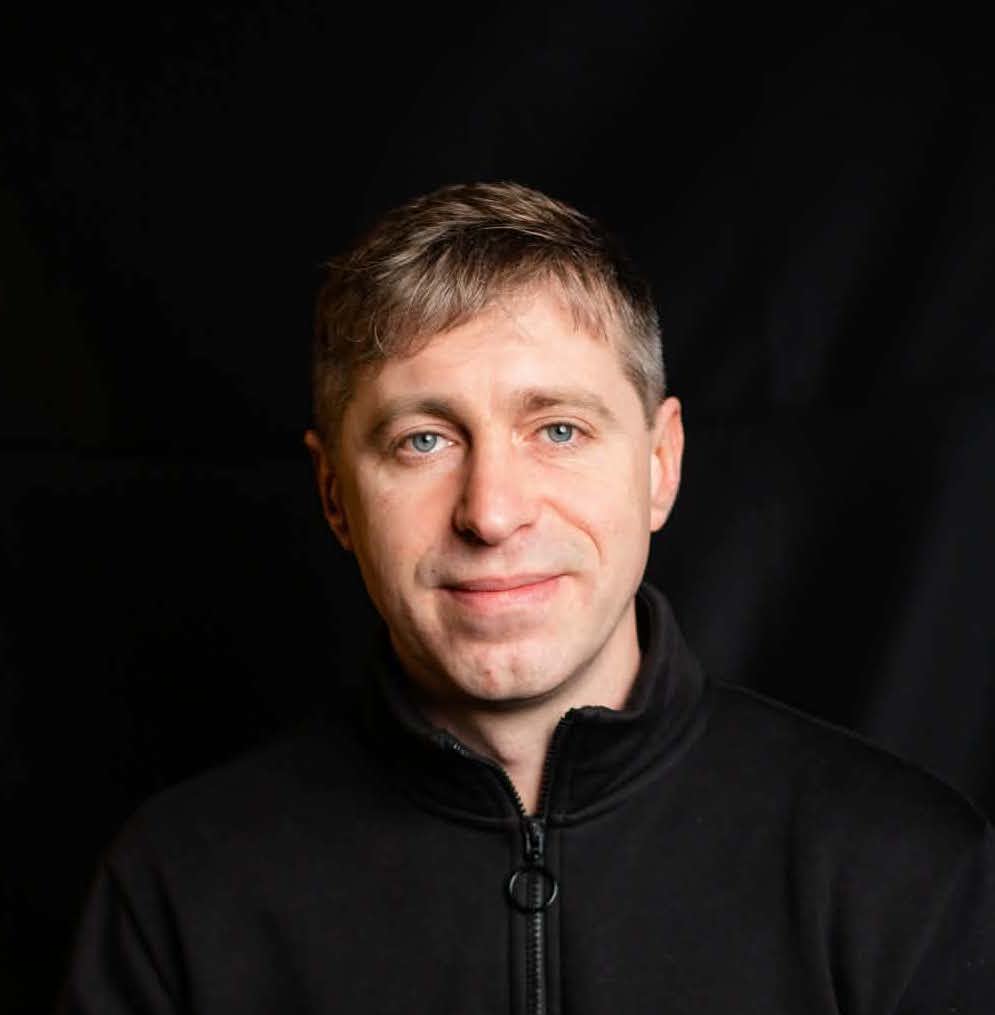
Ivan Hubenko is both a painter and a serviceman in the Ukrainian Army. In his sketchbooks, he captures everyday military life, drawing his comrades with a rare eye for detail and humanity. Kyiv Desk had the privilege of leafing through these visual diaries and speaking with Ivan about “men in caps” and the quiet miracle of drawing.

Serviceman, Sketchbook 2026
O.R — Ivan, before talking about your art and especially your sketchbooks, I would like to learn a little bit more about your childhood and your training as an art student in Kryvyi Rih, in central Ukraine. How was life in there for a young aspiring artist?
I.H — Kryvyi Rih is an industrial, gloomy city with tired and stern inhabitants. The picturesque nature and landscape of the city have been torn apart by quarries and transformed by slag heaps, mines, factories, pipes, and blast furnaces.
When I was studying art, it was difficult to find a place for plein air painting or for a classical landscape. Urban landscape painting was also challenging, because those rare old beautiful buildings had been disfigured by extensions, advertisements, and absurd, disharmonious facade painting. It was the 1990s — the period when capitalism and the market economy were emerging in Ukraine — and the active participants in that transformation paid little attention to architectural taste, principles of urban planning, or traditions.
This caused a sense of rejection in a young artist who was trying to seek motifs close to those of the classical masters. I felt a similar rejection toward most of the people around me. Although Krivyi Rih is rich in musicians and artists, the city and its inhabitants often diminish the value of creative people and their achievements.
Thus, during my formation as an artist, I constantly felt the unfriendly pressure of the environment and tried to create paintings with subjects, motifs, and situations somewhat detached from reality. At the same time, I always made sketches from life, and in this way I did not ignore reality, but rather observed, depicted, and documented it.
Later, after moving to Kyiv, I began to see the motifs and characters of Kryvyi Rih in a different emotional light. It felt as though I had fallen in love with my hometown all over again, and Kryvyi Rih came to the forefront of my artistic practice. I developed a character — “the man in the cap” — an image I continue to work with to this day. It is a generalised image of a Kryvyi Rih worker: during my youth, caps were worn by the overwhelming majority of men working in mines, quarries, factories, and industrial plants.
In summary, my development as an artist took place in opposition to the reality that surrounded me, accompanied by a feeling of hostility from the environment in which I lived. But over time, a kind of creative imprinting occurred within me, and what had once seemed negative and unacceptable — yet was also my first conscious experience of observation and representation — became something close to me and eventually formed the foundation of my artistic reflection.

Serviceman, Sketchbook, 2026
O.R — This “man in a cap” in your paintings is quite a haunting character! To me, he could be a relative of Murnau’s Nosferatu, even one of Goya’s colossi… He’s a ghostly, enigmatic presence, sometimes hovering above the world. Today, you are a serviceman and you draw in your sketchbook from nature: people, trees and animals — the everyday life around you. And still, it seems that “the man in a cap” hasn’t disappeared from your life. I’m thinking of the way you portray other “men in caps’ — the soldiers…
I.H — That’s true — I find myself once again surrounded by caps. But now I am wearing one myself. For me, the cap is a generalised symbol, almost a sign. Yet beneath every cap I try to find or imagine an original and compelling story, as if to “remove” that cap. Working with the monotony and conventionality of reality, I transform an anonymous passerby, endowing him with my own moods, thoughts, and attachments, placing him in locations that are dear to me. I give something of myself to people who are otherwise strangers to me — the things I value most, what concerns me now, what I love.
In the army, I gained the experience of prolonged communication with people who, in civilian life, would probably have remained mere passersby to me. This experience has blurred the distance between the artist and the people he depicts. On the one hand, this proximity allows me to notice in some people certain traits or manifestations that, within my artistic practice, could become their metamorphoses. On the other hand, there are periods when my needs narrow and my goals change: I stop feeling like an artist and become a full-fledged soldier. This experience has given me a new and unexpected perspective. Last year I managed to paint only a single painting, but it was created precisely from this perspective, and that is why it is so important to me.
The comparison to Goya is flattering to me, while the reference to Nosferatu is very interesting and unexpected. Perhaps there really is something unsettling, ghostly, and alienated in the “man in the cap.” But for me he has never been a figure of horror. Rather, he is someone who seems to dissolve into his surroundings, becoming their shadow or imprint. Perhaps this ghostliness emerges from the very way I perceive people — through distance, solitude, and an attempt to see something metaphysical within the ordinary.

Servicemen, Sketchbook 2026
O.R — This question of distance is fundamental for the viewer, too. When we look at your drawings of the soldiers, we sense immediately that they are in a kind of intermediate place, where the individual is physically present while, at the same time, the soul is withdrawn. Very often their faces are shadowed by the caps, or their eyes are half closed, lowered when they are lost in their thoughts, reading messages on their phones… And sometimes you even depict them asleep. A moment of both vulnerability and secrecy. Apparently, we can’t reach them, they are inscrutable. And yet, the incredible thing is that we don’t feel rejected or estranged: it’s quite the opposite! The soldiers’ solitude becomes ours. Do they notice when you sketch them? And, if so, how do they react?
I.H — The first thing that struck me in the army was the physical proximity of a large number of strangers. I still cannot fully get used to the kind of physiological and emotional openness that is difficult to avoid in such conditions. On the other hand, this closeness offers an almost unlimited potential for gathering material as an artist — and I take advantage of it.
As for my comrades’ reactions to being drawn, in general they are neutral, even indifferent. Though some of them become curious, ask to look through my sketchbook, and I have even gifted a few of them their portraits.
I have developed a kind of professional artistic voyeurism: I know how to observe and document people while remaining almost unnoticed. And of course, smartphones also play their part — people looking at their screens simply do not notice me, while drawing in a sketchbook resembles interacting with a phone in some way. So I manage to camouflage myself rather successfully.
O.R — Earlier, you mentioned the only painting you managed to create last year from a new perspective which was a direct consequence of your everyday life as a serviceman. Could you tell us a little bit more about that piece? What makes it different from your previous works?
I.H — This painting is called Plein Air. Plein Air is direct and perhaps overly explicit; it is a reflection on the new conditions I am trying to adapt to. In this painting, the ambiguity and uncertainty that I deliberately cultivated in my earlier works are absent. There are no hints or metaphysical undertones here — it is rather an illustration of the discomfort of transforming from a civilian into a soldier.

Plein Air, 2025, 120 x 90 cm, oil on canvas

Ignoramus, 2022 year, 70 x 100 cm, oil on canvas
O.R — While we are talking, I am browsing one of your amazing sketchbooks. What really strikes me is the alliance between the humility of the approach, the raw material (only small sheets of paper and graphite) and, at the same time, the strong presence of your studies, their physicality, and the truth of the instant. I read somewhere that you were very grateful to your ‘old school’ teachers during your academic training. Please, could you explain exactly what you learned from them?
I.H — The teachers with whom I studied were deeply committed to a classical academic approach. Particular attention was given to anatomy, perspective, tonal analysis, composition, colour theory, and the psychology of perception. To a certain extent, creative freedom was restricted in favour of strict adherence to academic principles. This gave me a fundamental understanding of how people perceive the world and provided me with the skills necessary to represent what we see in a realistic way.
Beyond craftsmanship, my education instilled in me a disciplined approach to artistic practice. It was this discipline that allowed me to remain an independent artist. Early in my career, I consciously chose not to rely on painting for my income. Instead, I earned a living through other professions — graphic design continues to provide me with financial stability. At the same time, I always reserved time and resources for my own artistic work. In this way, I protected my practice from dependence on galleries, market trends, or the artistic mainstream.
Of course, alongside rigorous academic training, we also studied art history. Most of my teachers were practicing artists, and we had the opportunity to visit their studios. At that time, Krivyi Rih had a vibrant artistic scene. In addition, I come from a family of artists. All of this helped shape my taste, my attachment to certain artists, and provided the foundation for discovering and understanding myself as an artist.
To summarise, my education gave me both a sense of direction in art and the skills necessary to pursue that direction. Incidentally, the habit of keeping a sketchbook was also instilled in me during my studies. My tutor insisted that students maintain a constant working rhythm through quick sketches. I continue to do this today for exactly the same reason — to keep my artistic eye and hand in shape. The only thing that changed after I joined the military is that sketching became almost my only artistic practice and my primary form of expression. About a year ago, I arrived at the conceptual conclusion that a sketchbook can be more than preparatory material for a painting or a sculpture. It can exist as an autonomous work in its own right — much like a collection of essays can stand as a literary work rather than merely serving as notes for something else.

Landscape, Sketchbook 2026
O.R — Sketchbooks are fascinating objects, indeed: on one hand, we’ve got sketches that are supposed to be traces of works in progress or instant glimpses, and, on the other hand, these sketches are bound within… a book. This format gives the eyes a direction in terms of time and space, tempting us to say that we actually “read” the drawings. What do you think? Would you say your sketchbooks contain their own narrative?
I.H — Yes, absolutely. They are a kind of diary. Each sketchbook is another volume of that diary. It was precisely through developing this idea that, thanks to INDEX, we organised my exhibition Tagebuch last year. The exhibition was built around my sketchbooks and a number of paintings that originated from drawings contained within them. I deliberately chose the German title Tagebuch (“diary”) because it contains the word Buch — “book.”
So, I think you are right: I see my sketchbooks as a kind of literary work in which drawings replace text. But it is not a novel with a premeditated plot. Rather, it is a diary in which the story forms by itself through the accumulation of observations, experiences, and lived days.
Interview conducted on June 1, 2026
Header photo credit : Ivan Hubenko © Nastya Telikova

Servicemen and a dog, Sketchbook 2025

Servicemen, Sketchbook 2025

Landscape, Sketchbook 2026
Discover more of Ivan’s art works on:
saatchiart.com
Regularly, Ivan posts his drawings on Facebook and Instagram.
https://www.facebook.com/ivan.gubenko
https://www.instagram.com/gubenkoivan/


Leave a Reply