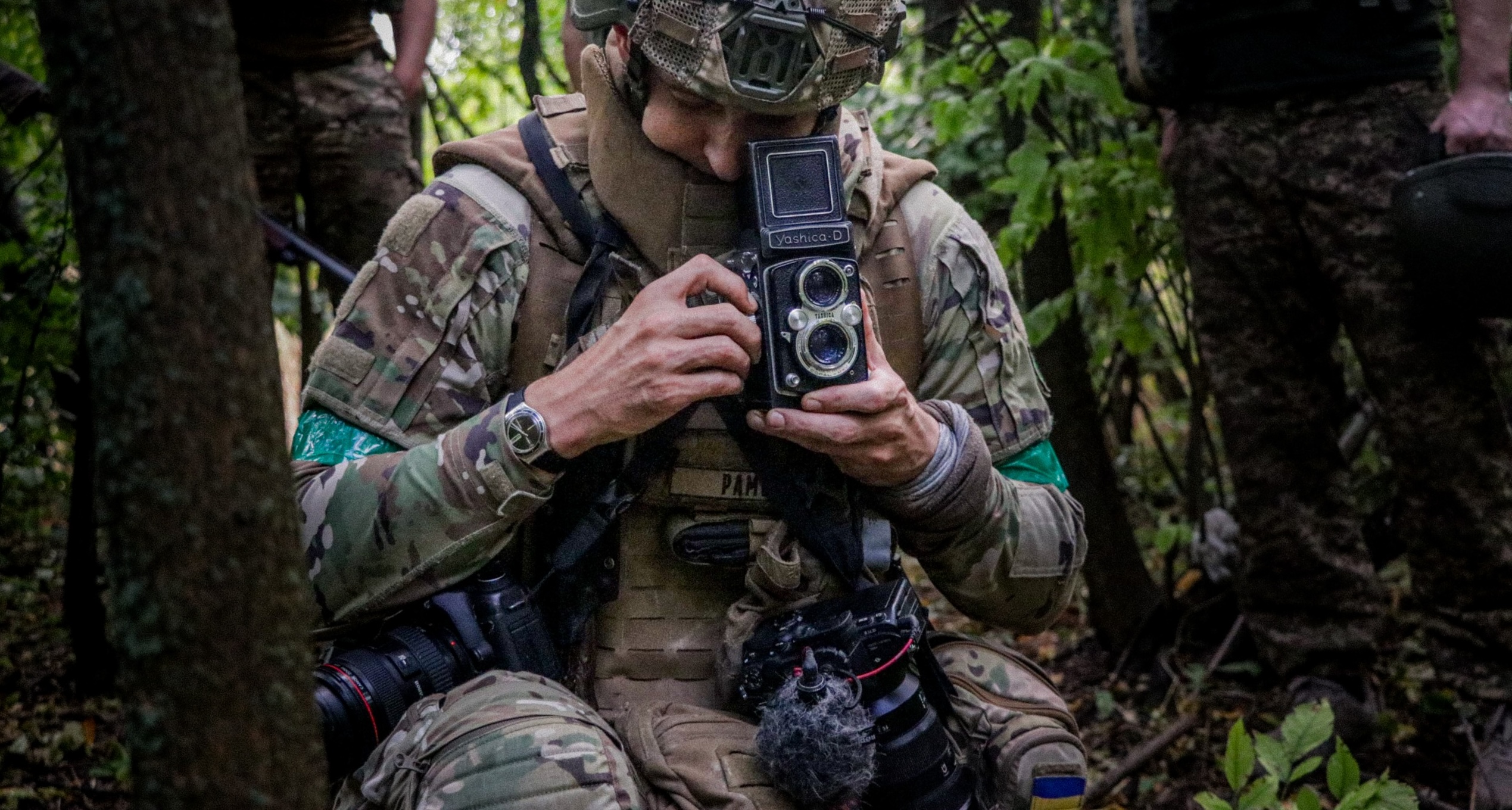
“I joined Azov in November 2023 because they needed someone with a camera, and my perspective resonated with them. I never thought such a match could happen. A legendary brigade and a little-known photographer from a small town — how was that even possible? I couldn’t let them down, so I’ve been doing my absolute best since the very beginning of my service until now.”
A unique interview with war photographer Roman Zakrevsky.

Snipers. Donetsk Region. Spring 2025
I.I.O – Having visited you there many times, and because you introduced me to your city and made each of my visits a memorable experience, to me you embody the very essence of the “Chernihiv boy”. If you don’t object to the label, would you be willing to explain to a wider audience what it means to be a Chernihiv boy?
R.Z – Yes, I am a Chernihiv boy, as you say. But, as I grew older, I could see that there are a lot of different variations of the quintessence of this picture. It depends on the region in which you grew up. And it depends on the people with whom you grow up, your parents first of all. Now I can say that I grew up in a strong, well-built, classical Soviet family in which my grandfathers were military servicemen and their wives, a teacher and what was then called a shop manager.
Two of my grandfathers passed through the war: one as a pilot, the other as a child of war in Belarus. The first one became a CEO of a big plant that manufactures vehicles; the other became a lieutenant colonel in the central city military base, in which my older brother is serving now. So, I had a lot of toys, a lot of butter on the table (which I have really liked since I was a little boy), and a big family who all came together on one big dacha to put vegetables in and out of the ground to feed 12 mouths who lived in one city every weekend when the collapse happened in 1991. I was a very small person at that time, and I remember that big family sitting near a big tree on the grass to eat; a variety of foods appearing on beautiful old tablecloths. Now I see that those were hard times for everyone, and those rich things in life that we had made us feel rich. But these memories warm my heart now, because now such a big gathering of our family is impossible.
I know someday it will happen because my older brother, my cousin, and I now have our own children. But it will be a very different meeting, I guess.
That’s where my roots are. Simple people from Ukrainian and Belarusian villages who came through hard times and moved to a small but very old and beautiful town, got everything they had with their own hands, and loved each other till the end of their lives. Such were my parents. My father is still here, but my mother passed away.
She was in charge of our family. A secret matriarchal regime that controlled three boys: a husband and two sons. My father knew how to deal with it because his parents were mostly from a “control planet” in the space of the great communist future. But he never forgot about the land that he had. My grandfather, who was a pilot in WWII, was very sad and waited until the last moment because he didn’t want to sell the two gardens that we had beside our dacha.
He got two flats in the longest building in the city that everyone called the “Chinese Wall,” into which my family and my grandparents moved after the two-story house in which my father grew up was destroyed to build a new district. Actually, the house was dismantled and became a dacha that still exists, on which my father still works — the last one from that generation.

I.I.Oblomov, Father and Son, Roman and Yuryi Zakrevsky, Chernihiv, 2017.
My parents were engineers at the same plant in a secret department that did some stuff for Soviet satellites. There they met in 1979. My brother appeared in the 1980s, and I in 1986. My father was dreaming about a girl as a second child. But he got a Virgo (boy) instead. I was a kind, blond-haired boy with a big head. I was very obedient and shy, always listening to my grown-up relatives as a good boy. But in this limited space, I had the opportunity to do all that my cousin’s and my fantasies gave us. We did a lot of good stuff with our hands (from snowboards to baseball equipment) with all the support of our relatives; I could bring all of my neighborhood friends for tea, and my parents wouldn’t rag me at all; I could give all of my (mostly my older brother’s) toy weapons to the whole hood to play with, and nobody told me anything.
But on the other hand, I had to wear, behave, and do things in a special way which only my relatives knew. It worked well until I became a student. I fell in love and started to get involved in photography, and for my parents, this interest became very scary. Because they figured out: this “not serious thing” called photography was becoming so important to me that the only thing that I started telling them was that I would become a well-known photographer.
That was the wrong plan for them. But not for me.
On the one hand, they were supporting me with food and pocket money for a long time — I left them and started living by myself when I was 27, and still they paid the bills for their own flat (my mother’s parents’) in which I was living, even if I could have done that myself (not every month, but I could). You see, I could not understand the value that I brought to this world with my photography. That’s why I couldn’t sell it. I dreamt as a boy of taking a person’s portrait, printing it, and giving it away for free. Thanks to my relatives, I fulfilled this dream many times. But I was never understood as a photographer. They waited and wanted me to find a “normal” job. Only one of my grandmothers supported me until the end (she passed away a week after my military service as a war photographer, which I had been dreaming of becoming at the beginning of my “career”) and my father, who always told me that he understood me and my choice to find my own way in this life.
I’m crying like a little boy now, remembering all my relatives who passed away and the love that they gave me.
I.I.O – Among other things, you introduced me to the joys of lavish meals at the dacha, at a generously laid table set up in the garden, and your father planted a cherry tree for me – or, more precisely, for my character. I do hope I will taste its fruits someday. I have never felt so deeply rooted in Ukraine as I did that day. But let’s get back to your early days as a photographer. It seems to me that they’re largely tied to a small artistic circle into which you fit perfectly. Even before meeting this group, I already had an image of it through your photos that I saw circulating on social media. It gave the impression, above all, of a cheerful group of friends who took great pleasure in sharing and living together, and where creativity seemed to be the result of friendly interactions rather than from an isolated endeavor. On each of my visits, you introduced me to a number of your friends who belonged to that circle, some of whose faces were already familiar to me, though I never imagined I’d meet them in real life. I’d like you to tell us to what extent this community has allowed you to develop your practice and your identity as a photographer.
R.K – Well, from the perspective of where I am now, all my connections with this small circle of artists started through my friendship with Serhiy Tonkanov. We have known each other since childhood because we grew up in the same neighborhood in Chernihiv. Most of the time when we were small, Sergiy was hanging out with older guys from the hood. But when all the older boys entered university, we lost touch for a while. I don’t remember exactly how we reconnected, but it was around the time I started taking photos – maybe he saw me with two cameras in the yard.
From the very beginning of my engagement with photography, we did a lot of things together. He had a large art space in the Museum of Modern Art in Chernihiv, which he used for his work with metal, plastic, and oil paints. It was there that we held my first “studio” photo sessions with friends we knew personally. A year later, we organized a joint exhibition called “Their Diaries,” featuring naive photos framed in old window frames found in city junkyards, alongside Serhiy’s first oil paintings. That was in 2007.
After that, I was warmly welcomed into the local underground art community, where Tonkanov was already a figure because he studied oil painting under the master Yevgeny Krip. Slowly, I got to know all the local underground legends, and year by year, we started collaborating on artistic projects.
Somehow, the way I approached photography was new or unusual for this community. Many people in that circle used photography merely as an additional medium for their work. But as for me, I was totally consumed by it, shooting three rolls of film a day and sharing printed photos with everyone I could reach. I was trying to do my best because I was naturally a shy person; perhaps that’s why the camera became my key to people and the world around me. This “key,” combined with a heartfelt love for all the people who accepted me as an artist, turned my photography into something highly valued. Within a couple of years, I started hearing people from both within and outside our art community say things like: “Oh, you also have a portrait by Zakrevskyi?” or “Is that a Zakrevskyi photo on your social media? Cool, he made my portrait too.”

Serhiy Zhadan. Ukrainian writer. Chernihiv 2015

A Couple, 2017
Our entire community wanted to find a physical space in town to work and hang out—somewhere warm to settle down, as it wasn’t possible to organize activities outside all year round. That’s how “Torba” happened—a little shop where we tried to sell our handmade goods. Then came “Art Workshop Remzavod”—a gallery and a space for masterclasses with a cozy inner yard for watching classic movies outdoors. During that time, before the full-scale invasion, we had the freedom to organize all kinds of exhibitions and gatherings because everyone had the inner drive and personal resources to participate. We didn’t have any bosses; our teachers were local elder artists from the art school or music college, as well as world-class masters whose interviews, books, and movies we studied. Most importantly, we had each other to share experiences, work together, and invent new things. Our imagination had no boundaries. The only persistent problem was money, but it never stopped us. The local environment is very rich. And one more thing : we were young and constantly learning.
The official cultural “managers” of our town didn’t notice us at all, and we didn’t notice them. To be frank, we knew they were dull and greedy, and they were never truly interested in art. In 2021, it was actually funny to see the head of the city’s cultural department looking surprised and confused when he visited “Chernihiv Monumentalism,” a three-day festival we organized ourselves through local business crowdfunding. It was the first festival of its kind where we showcased and rediscovered large local outdoor mosaics and indoor stained glass, showed original sketches, and invited the authors or their relatives. This event proved to the entire Ukrainian art community – many of whom visited the festival – that we are here to save the heritage of past generations and show how culturally rich our local area is. And this continues to happen, no matter how far we are from each other due to the war in our country.
All these things need to be captured by a camera. That is what matters most to us: freedom in art, personal connections, the absence of money or pretense, and a true belief that we are a vital part of world culture.
I.I.O – You beautifully describe a mindset and an approach that I intuitively sensed, without fully understanding their origin or all their implications. When we met in Kyiv in December 2016 – where you were living at the time, hoping, if I’m not mistaken, to give your photography a new impetus – I told you that I wanted you to participate as a “model” in my project on playgrounds, and I was of course very curious to meet you, without knowing if anything more than just another photo would come of this encounter. It turned out that we got along wonderfully right away, realizing that photography fulfilled a need we both shared to meet other people, understand them, and, ideally, make friends with them. In a spirit of reciprocity you were already accustomed to, you took a portrait of me against a black background for your series “Where We Are”, adding me to the ranks of your models, and I returned the favor by taking a portrait of you sitting in your kitchen, enveloped in wisps of smoke, for my series of the same name. That’s when I started making a habit of visiting you in Chernihiv, where you soon returned to live, hoping also to meet and photograph your friends, and to draw on your boundless resources whenever I wanted to give my character Oblomov a breath of fresh air and find him a rural setting. Even though you explore a wide range of themes through photography, I see you primarily as a portrait photographer, with your own unique and instantly recognizable style. Aside from your “Where We Are” project, could you tell us about other photographic projects you’ve undertaken, up to the work you’re doing today in the military, which seems to be a natural extension of that?
R.K – Most of the time, I worked on a single picture. It didn’t matter which one: a portrait, still life, landscape, or street photography. I just wanted the picture to have something that goes beyond form – something that speaks directly to the viewer, creating an image in their mind. I never thought about, and hardly understood, what it meant to “make a project” or where to find context. The meaning of that word was completely lost on me, but after the full-scale invasion, I clearly understood it.
On the other hand, I’ve experimented a lot with different cameras and lenses, discovering how they catch light and color. When I found the one I liked, it became my long-term instrument. That is how most of my series come to life.
I spent most of my time in my hometown, so my photos were often similar. The only changes were in the seasons, locations, or circumstances that naturally occurred while I was searching for a shot. I found my favourite routes, favourite courtyards, and favourite people to visit. I like things that repeat themselves (just as history does), so I was comfortable with a life that looked mostly the same. At first, I was worried that nothing interesting would come my way, but later I figured out two major things. First: just follow the light, and it will give you the picture you’re looking for. Second: follow the people. Get to know them better, go where they are, and you’ll find new situations, backgrounds, and angles for a new photographic experience.
My long-term engagement in photography has shown me that I focus on several themes: portraits, landscapes (specifically natural surroundings), the streets of my town, and objects. In my “things” theme, I enjoy taking pictures of simple still lifes – either staged compositions or objects I’ve encountered outdoors and in new places with new people. I love people. I love them even more than myself, and I want to capture their portraits to show how beautiful they are, often presenting them with a print as a gift whenever possible.
I love the beauty of nature and the harmony of color and form. These were the first things that drove me to the fields and forests around Chernihiv early in the morning, even before sunrise. Later, I focused more on urban landscapes where nature enters into a strict dialogue with people who try to make it obey. Some elements of this dialogue are beautiful, while others are ugly. I’ve approached them as an external observer, trying to find a harmony of light, color, and form within what often looks like uncontrollable chaos. Logically, still life and object photography became a microscope for this dialogue, bringing me a lot of joy through unexpected and surrealistic stories.
But my main goal and overall concept for all my work has been a desire to create pictures beyond time and space – images where the viewer can see connections to world art, from ancient times to the modern era. Only through small details or subtle signs can the viewer understand where and when a picture was taken. I believe that everything created by nature or mankind is imprinted in the people, landscapes, and objects that are right here, where you are.
Speaking of photo series, I have several. First of all, there are my multiple-exposure photographs taken between 2008 and 2017. I would simply walk around, shooting what I liked until the end of a film roll, then rewind it and put it back into the camera. This meant I didn’t truly know what was on those frames after the first round of shooting. Those double exposures happened without a plan, becoming independent worlds within a single frame. These uncontrollable results made me truly happy; I felt like a real artist because I don’t think I have enough imagination to invent such images on my own. Seeing these images after developing the film was truly magical.

Untitled. Squares series. Chernihiv, 2010.
Another series I titled “Squares” because it was created between 2009 and 2012 using a simple plastic point-and-shoot camera, inside which I placed a square frame made of black paper. I remember being very inspired by Cartier-Bresson’s street photography and his “decisive moment” at the time. That camera, with just one button to push, was the perfect instrument for me. The homemade square frame and the imperfect mechanical features of the plastic camera made the pictures feel raw and interesting to create and show to the world.
Another series I really like is “Myopia.” All my life, I have been fond of Expressionism in oil painting. When I bought a small digital Fuji camera with perfect color rendering, I paired it with an old Soviet lens. I reversed the front element of the lens, which created a strange, soft focus where only light and color mattered. Objects and figures became blurred, yet retained a film-like quality. I took many pictures with that lens, rediscovering a sense of freedom – this blur protected me from angry people asking, “What are you taking pictures of?”
My most well-known work to date is the “Where We Are” project. It is a series of black-and-white portraits featuring people against a black background, with nothing in the frame except the person. The idea for this long-term project grew out of my love for people and began as a birthday gift for a friend celebrating her 18th birthday at my flat in Chernihiv, where I moved in 2013. I took the first portraits of all the friends who came to greet her in 2016. Afterwards, many of them changed their social media profile pictures to these black-and-white portraits. From that day on, during an extremely active six-month period, more and more people came to me every day for this kind of “avatar” picture.
But this wasn’t a “sit down and push the button” type of project. For many who had the courage to come – most of whom didn’t know me personally – it was a strange journey toward discovering their true beauty. We sat right in front of each other, sometimes talking for hours, during which I captured calm portraits of the newcomers. I rarely used studio lighting; my bedroom served as the studio, and we sat in almost complete darkness. This was intentional – to help the person find inner calm and a natural, comfortable pose. In that darkness, only my questions about life and other personal matters could be heard, interrupted only by the sudden, bright flash of the camera cutting through the gloom. I never thought this simple idea of “natural portraits” would have such a big impact. To me, “natural” means finding that specific moment where a portrait can change a person’s perception of themself. By the end of that year, I had photographed more than 1,000 people. While staying at home, I welcomed not only people from Chernihiv, Kyiv, and other parts of the country, but also visitors from Australia, France, Norway, the USA, and Brazil.
During the first two years of this project, I realised that there are more things that unite and connect us than divide us. Despite our different backgrounds, we all want the same thing: attention, acceptance, and a person who truly understands and sees beyond our outward form, even if only for an hour during the shoot. Another thing I noticed is that most of us do not truly see ourselves. People have mirrors at home in which they are good-looking, yet they often have a distorted perception of themselves. I frequently heard phrases like “I’m not photogenic” or “I don’t know how to pose.” For many, this was their first-ever photo session (perhaps because I didn’t charge for it). This was exactly what I was fighting against – trying to create a picture that would change this perception, to show them that they are okay and truly beautiful. The best reward for me was seeing faces full of surprise and hearing them say, “Is that me? No way! I never thought I looked like this.”
That’s why I called the project “Where We Are”. It’s not a question; it’s a state – a moment in which a person begins to see themselves in a different way. It’s the moment they truly see themselves: whether tired, sad, happy, or depressed; younger or older than they thought; beautiful or simply different from what they were used to.
During these nonstop shoots, I took portraits of couples in love, and then later, I photographed them again after they had broken up and returned on their own. I’ve taken portraits of people right after they married, and then saw them return with their children. I’ve made portraits of people during the hardest times of their lives, and of them and their friends as birthday gifts. I’ve done portraits of people with their dogs, cats, and other pets. This project was like a flow of reality in which I was really interested in what kind of people could come to me. So, my doors were always open. I even took a picture of the whole amateur theater troupe. They all came to see me together.
To be honest, “Where We Are” is like a deep ocean that I’ve dived into; I spent so much time there but never truly looked back or processed the experience. Most of the pictures remain unpublished. I suspect there are even some I still haven’t sent to the people I photographed. I was always in a state of constant action until I hit burnout in 2017. After that, I still continued to do it but not on such huge scale because I decided to make this a lifelong project – I can do it anywhere there is a sofa or a chair and a wall where I can hang a black cloth. But I am still afraid to look through all those pictures and do something more with them than just keeping them on my computer. Yes, there were exhibitions in Kyiv, Chernihiv, and Ostroh, but the main exhibition is something I am still planning.
I realize now that this project will be truly timely when I return after the war. For the new generation, I imagine it will feel like something “old school” yet simultaneously new. For those who took part before the full-scale invasion, it will also be an emotional trigger – a chance to feel themselves again against that black background, with nothing but their own presence, and to see how time has changed their appearance. It will be a good moment to remember the “good old days” and to talk about everything that has changed since then, and how it has changed us.
All the experience I gained as a civilian photographer has been incredibly useful for my military service. I joined Azov in November 2023 because they needed someone with a camera, and my perspective resonated with them. I never thought such a match could happen. A legendary brigade and a “no-name” photographer from a small town — how was that possible? I couldn’t let them down, so I’ve been doing my absolute best since the beginning of my service until now.
My ability to communicate with people, to find the “key” to a portrait, and my experience in searching for the best angle or moment helped me take some good pictures of our guys on the front line. To be honest, when I was younger, I had a dream of being a war photographer. I thought it would involve traveling to “hot spots” in other countries, never imagining a war in my own homeland.

Medics at the triage point for the wounded. Shcherbinovka, summer 2025.
I always struggled with money; sometimes I had film but no money to develop it. In the army, I finally have the means to buy and develop film because my brigade supports its media department very well. One day, I bought a medium format camera and some black-and-white film. Before that, I had a plastic Soviet camera with a dull viewfinder and poor shutter speeds. With it, I shot five rolls of B&W film given to me as a gift by my friend Francis when he was leaving Ukraine he loves so deeply because of the war. I took portraits of instructors and documented training sessions for recruits starting their military careers. Then, one day, while sitting in a dugout with no work to shoot, I accidentally found a camera on Facebook and realized I could afford it. For the past two years, I’ve taken my Yashica D along with two digital cameras everywhere to take portraits of our soldiers. Here, I’ve realized that a simple act, like taking a picture, can make a person truly happy. Simple things in war are vital: they save lives, shape personal attitudes, and are priceless over time. This is especially true for a good picture of a man spending his best years serving his country, fighting for freedom with everything he knows and all he has.
As long as I am here and as long as the war continues, I will take film portraits of everyone I meet. My goal is to print them later and send them as a lasting memory. I don’t know. Maybe I’ll make a book out of them someday.

Infantryman after training in the vicinity of Sloviansk, spring 2024.
I.I.O – That is my heartfelt wish for you: that your work be fully recognized, exhibited, and published. And that it be remembered as an essential record of this era. There’s another aspect of your work I’d like to touch on now: your role as a cameraman. With that camera – or rather, those cameras – that never leave your side, you’ve created both moving and still images. Can you tell us about your experience at Suspilne, and first introduce this major Ukrainian media group for those who aren’t familiar with it? I believe that was your first experience as an employee, with all the constraints and benefits of the role. What did you take away from that? I’d also like you to tell us about the filming of Livia Barkar’s movie, which took place largely in my apartment in Kyiv, and where you served as the camera operator. Since I never saw anything of it other than a pleasant chaos and the friendly troupe of young actors, this might also be a good opportunity to give a brief summary of both the shoot and the story.
R.K – I remember the first time I visited a documentary film festival at our local cinema. I watched only one film, but it shocked me with how deeply the camera operator, using a simple Handycam, immersed themselves into the lives of teenagers. I was so inspired by those moving pictures that I immediately started looking for a way to create something of my own. In 2009, I bought a digital camera. From that day on, I started shooting not only photos but also videos. Most of them were long documentary recordings of cultural events and gatherings of friends that I attended. I edited them in Sony Vegas into long reels – for instance, about the openings of my own exhibitions or those of my artist friends – and uploaded them to my YouTube channel. Ever since watching that movie at the cinema, I dreamed of making a documentary, and I was truly happy just making videos with the camera I owned. When my financial situation became critical and I desperately needed a regular job, I started looking for opportunities connected to video production. At the time, I had a low opinion of myself, thinking: “If I can’t make enough money with photography, maybe I can do it with video.”
My first job as a camera operator was at the Chernihiv Philharmonic Center, where I filmed stage performances. However, I was fired because they wanted me to do absolutely everything: take photos, shoot videos, and edit them all by myself. Neither I nor they had the necessary equipment for that. In the end, it felt like a relief when they let me go, especially because I already had a Plan B.
At that time, my childhood friend was the chief producer at the local affiliate of Suspilne. Suspilne Ukraine (the Public Broadcasting Company of Ukraine) was established by reforming the old Soviet-style state television and radio system, fulfilling a key requirement of the Council of Europe and the European Union. The broadcaster was officially launched on January 19, 2017, with the legal registration of JSC “UA:PBC”. There was a local channel in every region of Ukraine. Back then, I was fascinated to learn how television worked from the inside, so I called my friend and we set up a meeting. He had known me for a long time as a photographer and understood my vision of the world, so he gave me a chance to try. It was a completely new experience for me. I was used to working alone, but suddenly I was surrounded by a lot of people, each with their own personality and duties. These people were very different from the local art community where I had grown up as an artist and a person. Essentially, they were more like “people-functions” rather than individuals truly passionate about their work. It was hard for me to understand and adjust to this, because I looked at everything through the eyes of an artist trying to capture reality creatively. Many people there just came and went, doing their tasks without any passion. Not all of them, of course, but the energy exchange was poor, often spoiled by “star sickness” or difficult personality traits. I really couldn’t comprehend it.

Volo. Combat medic. Summer 2025. Somewhere near Sloviansk.
On the other hand, I learned the specifics of TV camera work from more experienced colleagues and traveled extensively around our region, visiting places I could never have reached as a regular photographer. One of my motivations for getting a regular job was the desire to attend a corporate event where I could just relax instead of taking photos, and to finally go on a vacation, which I had never had before. To be honest, the team I eventually found there was very friendly and highly professional. Based on our viewing figures, the content from the Chernihiv branch of Suspilne was watched by slightly more people than the Kyiv branch. It is hard to compare the feeling of going on a shoot during the day and seeing a story with your footage aired on TV that very evening. This is something only television can give, even if it is just routine work. I worked for Suspilne for over a year, then quit to be free in my creativity again, as there wasn’t enough time to combine it with a full-time job.
Later, my wife and I found out we were expecting a baby, and I symbolically returned to the channel on February 14, 2022 – just ten days before the full-scale invasion. A month later, we managed to leave the city for the western part of the country. I stayed there until May, and all that time I continued to receive my salary, for which I am deeply grateful to the channel’s management. I worked in television until September 2023 and quit because I found a space for a photo studio. I also managed to get studio lighting thanks to a friend who returned to Kyiv that summer to pack up his things and finally move back home to France. However, my inner state, combined with communication issues in my family and a lack of a clear understanding of how to monetize my work with the tools and experience I had, forced me to make the decision to join the army. Of course, this was only one of the reasons; I knew that one way or another, I would have to go to war. I think I got lucky because here I do what I do best: take photos and shoot videos. In general, everything that happened to me before this life-changing decision seemed to point toward this path. Even my camera memory cards started breaking down one after another – something that had never happened to me in all my years of professional experience.
Before working on television, I had experience as the chief cinematographer on a short film by a young director, Livia Barkar. We met back in 2013 at the legendary Dakh Theater in Kyiv when it opened its doors to look for new actors for its troupe. Five years after we met, Livia wrote to me and suggested making a film together. She said she had been following my photography all that time, and the way I see people and the world resonated with her as a director, especially for her debut film. I had long dreamed of making a real movie – to feel the vibe of that phrase I once heard backstage on another film set, and to act a bit like a director myself, shouting: “Silence on set!” I knew nothing about how to make a movie, but I believed I could frame a shot and understand the person inside it, and that was enough. Livia wrote the script, selected the actors and the crew, raised the money to rent equipment, and in the summer of 2017, we started shooting. To be honest, it was difficult but incredible. Livia managed to gather people around her project who understood each other without words. Despite all the organizational difficulties, circumstances worked in our favor. It was a dream come true for me: to live in Kyiv for two weeks and completely immerse myself in the filming process. I am incredibly grateful to her for choosing me as the cinematographer and for the fact that we made it happen together.
There was an interesting moment: for one scene, we needed to find an entire field of poppies. Liva refused to create it using computer graphics. However, by the time we were shooting, the poppy season had already passed. About a year later, she called me and said, “Roma, I found a place where we can shoot a poppy field. What are you doing tomorrow?” The next day, she, the main actor, and I drove to the village of Bylbasivka, located in the western part of the Donetsk region. Ironically, four years later, I found myself in that very village again – but this time as a camera operator for the media department of the Azov Brigade. I had just returned from my first combat mission with the infantry in the Serebryansky Forest and couldn’t sleep. My brother-in-arms and I went for a drive, and somewhere on the outskirts of that village, I found myself standing in a poppy field once again.

Drone operators on polygon, 2025.
I.I.O – As far as I know, you’re neither a singer nor a musician, but there’s always something inside you that sings; you have a tremendous sense of rhythm, which is also a way of singing life’s song. Everything can turn into an impromptu dance or a sort of musical number, accompanied by mouth noises or whatever object happens to be at hand, and your friends are always happy to join in. Likewise, you love playing with words; words aren’t inert things, but lend themselves to all sorts of inventions and twists, some of which I imagine will feed into the snippets of poetry you so willingly share with those around you. And in any case, we find that wonderful sociability and joyful way of being together that have always filled me with admiration. But now we’re hearing about a book. That’s a whole different story! It’s aimed, at first glance, at a wider audience than the close circle of one’s friends. Its release is scheduled for the end of May and is set to coincide with a major event on the Ukrainian literary scene: the annual book fair at Mystetskyi Arsenal in Kyiv. Why a book now? What is it about?

Inga Levi. Where we are project. Kyiv 2015
R.K – I’ve been writing something all my life, starting back in high school. First, it was funny poems. Then, alongside them, came stories full of naivety and human suffering. Once, I even published my poems in a local poetry collection. Later, when I was at university, I self-published a book. I remember the circulation was only 100 copies, and it cost just 200 hryvnias. They printed it for me right at my university. It was called “Spreading the Wings of Dreams” and consisted of short stories I had written during my first year at university. When I started taking photos, I realized that my poems went well with the pictures I took. Back in 2013, I made a small edition featuring this combination. This time, I printed everything myself. I glued the photos to the paper using double-sided tape and hand-sewed all the pages together. The poems never repeated; they were different in each self-published copy, just like the photos. All of those books disappeared somewhere into the hands of people I was communicating with at the time. I hope that someday they will resurface and find their way back to me.
At one point, I decided there were a few specific things I needed to achieve in this life. First, to open an exhibition. I’ve had many of them in Ukraine, but now I need to reach an international audience and exhibit somewhere in Europe or America. Second, to act in a play. In 2012, I played the role of a photographer – essentially myself – who was invited to photograph the Pope. Roman Pokrovsky, an actor from the Chernihiv Youth Theater with whom I collaborated closely at the time, was in charge of staging the play. Back then, we saw each other constantly. I would visit his house or the theater, we would drink coffee, and I would read my new poems, which I was writing a lot of at the time. Later, we traveled to Odessa to a small local theater and performed the play once. Through that, I fulfilled a double dream: to act in a play and to go on tour as an actor. Another dream was to shoot a movie as a director of photography. I achieved this with Livia Barkar, as I mentioned above, realizing the dream through a short film. Now, all that remains is to shoot a documentary. To be honest, I did something similar during my military service when I went out with the guys to infantry or artillery positions. The events that happened to me fit the laws of the documentary genre perfectly. The only difference is that, in the end, it all turned into short videos on YouTube. But when I say documentary work, I mean forty minutes of live footage where the events and characters are real and uniquely unrepeatable. Maybe someday I will get permission and copy those videos I shot during my trips to Siversk, Shcherbynivka, or the Serebryansky Forest, and edit my own documentary from them. By the way, I just remembered that when the full-scale invasion began, I always had a camera handy with me, and I filmed everything that was happening. On my YouTube channel, there is an already-edited video about the first days of the full-scale invasion in Chernihiv and the work of our Suspilne branch. In short, maybe you don’t even need to go to the middle of nowhere to film a documentary. Everything most interesting is happening right here in Ukraine right now.
I also want to play an unforgettable role in a feature film. I already have a showreel for this somewhere, which was shot – but never given to me – by the young Ukrainian director Nikon Romanchenko. We met when the filming of the movie Livia was taking place at Mr. Oblomov’s apartment in Kyiv. Nikon came over to us after the shooting day and filmed me making beautiful, crazy faces and acting for his camera. At the time, I called it my acting showreel as a joke. But I am completely serious about playing a role in a big movie.
I have always dreamed of writing a book. Not a self-published one like in my youth, but a serious one. I wanted a real publishing house to be interested in my texts and want to publish them. You may not believe it, but that’s exactly what happened. In my youth, when I imagined a book, something like a fictional novel based on historical or imaginary events would come to mind – with philosophical subtext and breathtaking dialogues. I thought I would take some stories from my own life and others from stories I had heard elsewhere. Then, I would spice it all up with historical analogies, adapting reality for my book. It was important to me that the book had no specific references to real events, places, or characters. That way, everything would seem abstract, but if you were familiar with the context, you could guess what it was really about. In practice, however, things turned out a little differently.
The war didn’t just completely change my life; when I found myself in the army, everything happening to me immediately turned into texts. Moreover, they seemed to be born on their own. The first sentence would pop into my mind the moment a new feeling touched my heart, and the text would pour out of me, word by word, as soon as I opened the notes app on my phone. I had long dreamed of something like this – for texts to come to me naturally. As a writer, it is my dream to let experiences pass through me and share them in print.
I didn’t even dare to dream that a book could come out of it. I simply wrote and, after approval from my command, posted text after text on social media. After each new trip to the positions, after events that are hard to conceive but which every soldier experiences, I wrote something down and shared it with the world. Bohdan Lohvynenko, the founder of Ukraїner, saw these texts and messaged me: “It looks like you are writing a book,” he said. I even saved that message and sent it to my father. It was the beginning of 2024.
Later, Bohdan and I called each other, talked, and agreed to prepare this book together. Because that truly is my dream – to write a book. And the Ukraїner publishing house volunteered to publish it. For me, everything was simple. For example, I would go film how our artillery worked. I lived with the guys; we ate and drank Chinese tea together, which I brought with me. I filmed how they did their job against the enemy, and then we ran together to hide from the return fire. I captured all of this on video, took photos, and when I returned to the base, I recorded everything that had happened to me. I memorized the dialogues I heard or participated in, noted various details and interesting slang the guys used, and wove them into the texts that were being born.
My main task felt similar to taking a photograph that you then need to give to the person you captured. It was the same with the texts – I wrote about them and for them. Even though I was constantly among people – since finding an opportunity to be alone in the army is no easy task – I was alone with my thoughts and feelings in those surreal, historical circumstances. I wrote about myself back then, remembered my childhood, how my life had unfolded, wrote about my family, my friends, and about Chernihiv before and during the full-scale invasion.
All of this gave me fragments of a puzzle that I assembled from the past, the present, and thoughts of what would happen after the war. I wrote frankly. The events and situations were not invented; they were exactly as I experienced them and as I managed to remember them. Yet, despite all this, the book is not really about me. It is the story of an ordinary person who lived an ordinary life outside of war, until the war entered his life in a way the hero could never have imagined. This is a book about the transition from civilian to military life, about the inner transformation of a person in extreme conditions, about what truly matters and what does not, and about what happens where the Ukrainian army lives and works.
For security reasons and in line with my plan, the book contains no mentions of specific locations or where the main character serves. However, those familiar with the realities of war will be able to guess these details from the descriptions of the landscapes and specific nuances. Yet, this book is precisely for those who are not immersed in the topic. In my opinion, it closes the gap between what is shown on TV or social media and the inner world of a person who, under highly unfavorable circumstances, experiences the realization of his youthful dream – to film war.
The book is set to come out this May and will be presented at the publisher’s stand at the book fair. I hope I will be able to attend and finally hold it in my hands; I have been waiting for its approval for over a year and had already accepted the idea that it might only be released after martial law ends. I am deeply curious about its future – who will buy it, who will read it, and what the reviews will be. I wonder how it might change my life. But I am already happy, knowing that, at the very least, my daughter will definitely read it when she grows up.
Interview conducted by Ilya Ilyich Oblomov on May 17, 2026
Header photo : Roman Zakrevsky by Friend Dart/Kalina Brigade.

Friend Nuar. Mortar crew member. Exit from the Shcherbinivka positions. Summer 2025.


Leave a Reply