
I went for a 4.5 kilometer run this morning. And yesterday I also ran 3 km. Sulfat and I are following a training program for his half marathon. I run for the company because I love it. Pushing yourself from the very morning makes the day feel more conscious and somehow more justified against everything that flattens it. In this life, if you don’t run, you can die from not having enough strength to make the necessary dash from an enemy drone.
I remember, I also started running last spring. And it’s a good thing I did. Back then, running in Slaviansk was fabulous. Along the surviving road between the lakes straight to Slavkurort for the pull-up bars, and back. You could swim there too, but for some reason I only realized it on the last day of summer 2025. There are salt lakes there. It’s almost impossible to drown in them – the pleasantly salty water holds the body. I had a great opportunity then to finally learn to relax on the water without much need to work my limbs. But we have since moved to another city, and now all that remains is to believe that this war will end where it began, and that we will one day return there.
I think those morning runs gave me the endurance I needed to make it through the longest and most dangerous deployment — a two-week rotation with the medics in Shcherbynivka, at a wounded triage point.
The plan was to spend two weeks in a small concealed basement with Internet access, living off freeze-dried food — there was a nearby well with drinking water — and simply taking it easy whenever there was no work to do. It turned out to be the exact opposite. Enemy assault groups kept pushing into our sector, so we were constantly on alert and, from time to time, had to leave the shelter to help hold the perimeter.
During those sorties, when being spotted meant almost certain death and lying in ambush watching for any movement around the position was terrifying, my whole body shook so violently that I discovered parts of myself capable of trembling I hadn’t even known existed. And the older guys were right: the prayer of a Ukrainian nationalist really does help calm you down. At moments like that, it seems to rise from memory on its own.
When the battalion’s supplies were available, they dropped water to us from a drone. Because the well was destroyed on the second day of our shift and a Russian mortar had already been fired at it. We ate sublimates once a day, because there was not enough water. One or two bottles of “Morning Dew” broke and leaked during the drop. There were three of us on the position. The drone could not bring more than five bottles.
We were also given NGU dry rations. You can eat them too. But compared to them, sublimates seemed like a restaurant delicacy. Although buckwheat with meat is quite tasty. I also discovered that instant oatmeal — the kind that comes in single-serving packets — can be eaten dry. It was as if I had breakfast or dinner and ate something sweet.
I also naively took two tea mugs, a tea table and all the necessary dishes with me. I thought that if there was enough water, we would drink morning and afternoon tea. Yeah, I got carried away. I only performed the ceremony once, when we entered the position in the evening. There was still enough water in the large plastic barrel, so I treated everyone to tea. The rest of the time I brewed a little shu when the coffee ran out, and poured it from a metal cup into three white porcelain bowls. Shu is the answer. Tested at infantry positions in the Serebryansky Forest.
We walked for two days. About 18 kilometers from the reservoir, to which we were brought in armored vehicles, then through Kliban Byk, the trenches behind it, and Shcherbinivka itself. We were spotted in the center of the village, at a crossroads near the bridge over the river, where a pile of our burned-out vehicles was rusting. My comrade from the LNG, whom I used to visit when we were still in the “Serebryanka”, lost part of his leg when the infantry entered the village on armored vehicles. Apparently, one of those burned-out vehicles was his.
When enemy drones spotted us, we managed to hide in some alcoshop. A drone was constantly flying around this point on an optic fiber and the 120-mm mortar was working for about four hours, firing everywhere except at our shelter. It’s good that they still didn’t see where we ran. The feeling that you’re being hunted is not very pleasant. Especially when the time comes to get out of that shelter. And again running under the collapsed houses and fences, constantly hiding in the bushes from the first sounds of drones overhead.
Another funny thing I noticed: when you constantly listen to the sky to see if something is flying or not, over time it starts to seem like something is constantly buzzing somewhere. It’s nerve-racking. Especially when you go there for the first time. There were two of us: Yato and I. Nifilim already had experience with such walks. This constantly caused him and Yato to have disagreements. Should we go or stay put? Should we wait or keep running to the next point on the route? It made moving around much harder.
By the end of the second day of moving toward the position, we were already exhausted. After constantly hiding in the bushes as we passed through the village — half under our control, half under Russian control — we finally ran to the medics. The position we were heading for was only 1.5 kilometers from the frontline infantry positions. It doesn’t sound like much. And it isn’t. But covering that distance in those conditions felt like running 10 kilometers. Time itself seemed to stretch for hours. Just like it did, back then, in the alcoshop.
But the last 100 meters to the position turned out to be downright epic.
We ran down the street, jumping over the bricks shattered by explosions, potholes in the road and power lines, shouting the name of the position so that the local guys would hear and get ready to quickly let us in. On one side of the road, a huge dark gray rain cloud hung above the horizon, from which a bright rainbow emerged. We were being drenched in heavy rain, the drops of which could easily be seen in the rays of the setting sun on the other side of the sky. You don’t take many pictures while running. This picture has remained in my head forever.
A terrifying and unforgettable picture. A picture of the apocalypse in the middle of a destroyed village and the hope that this mission would still be successful. And these thoughts, about the unique beauty and power of nature even in these terrible places, I still remember with love, as an example of the uniqueness of the surrealism of modern realities.
I was probably sent there because I was doing physical training. It’s unlikely that anyone from our brigade media team could cover such a distance and film continuously. In fact, I filmed the whole way there and back and even while we were holding a perimeter defense. There were no wounded. They were in the previous shift, and the next one after us. When Nifilim was wounded on the next rotation, I called him. He told me what had happened to him and added with a smile: if you come with me again, my friend, you’ll get some incredible footage.
I lost 7 kg during this exit with the medics. On the way back, four of us were already leaving, because we took the guy from the mortar team with us. On the day of the exit, he was waiting for us in the bushes 100 meters from the position. He had small fragments in his hand. Nothing prevented him from walking and running.
Back to running. There was one moment I remember especially well during the exit from Shcherbinivka. Near a broken bridge over a shallow river covered with reeds, we had to run as fast as possible. The whole area was open and there was nowhere to hide. Hiding under the remains of the bridge was useless — the enemy already knew the spot well, and it wouldn’t protect us from drones anyway.
So we ran out of the last shelter in front of us, one after the other. I was the third. Yato was running behind me. And when I had already started running and began crossing that wide and shallow stream filled with reeds, Yato suddenly started shouting from behind me: “DRONE!!!”
At that moment, it was as if I was on autopilot, because I started running so fast in my armor, with a backpack, cameras, and a rifle, like I had probably never run before in my life. I was also running so fast that I got caught, lost my balance, and fell right into the reeds in the middle of the stream, like into some soft spider web. I tried to get up quickly, but I couldn’t. I stopped moving because I heard the sounds of a drone somewhere nearby.
Out in the open, my body flattened into the dry yellow reeds with no cover anywhere around, unable to get up and move quickly, I couldn’t think of anything better than clawing at the reeds with my hands and trying, somehow, to hide my silhouette under them. I heard the sound of the drone very clearly and heard it flying towards me. I remember lying there thinking: damn, I’m not hiding here. It’s so soft here, lying in the lap of nature. Everything is fine. It was interesting hanging out with you, guys.
But the drone flew past me. I saw its skeleton and the camera looking ahead five meters above me. It was rapidly flying somewhere diagonally in the opposite direction of our group’s movement. When the drone flew past, I managed to roll over onto my side and Yato and I quickly ran towards Nifilim.
I remember one of our conversations in the basement of the wounded triage center on the eve of the rotation, which was postponed twice: when your life is on the line, run. Don’t even hesitate.
Hard to believe. Even harder to imagine. But it actually works that way. That’s why Sulfat and I run. He’s a half-marathoner. And I’m a drone pilot from Shcherbinivka.
R.Z.

R. Z, Training in trenches with drone and camouflage, 2025.
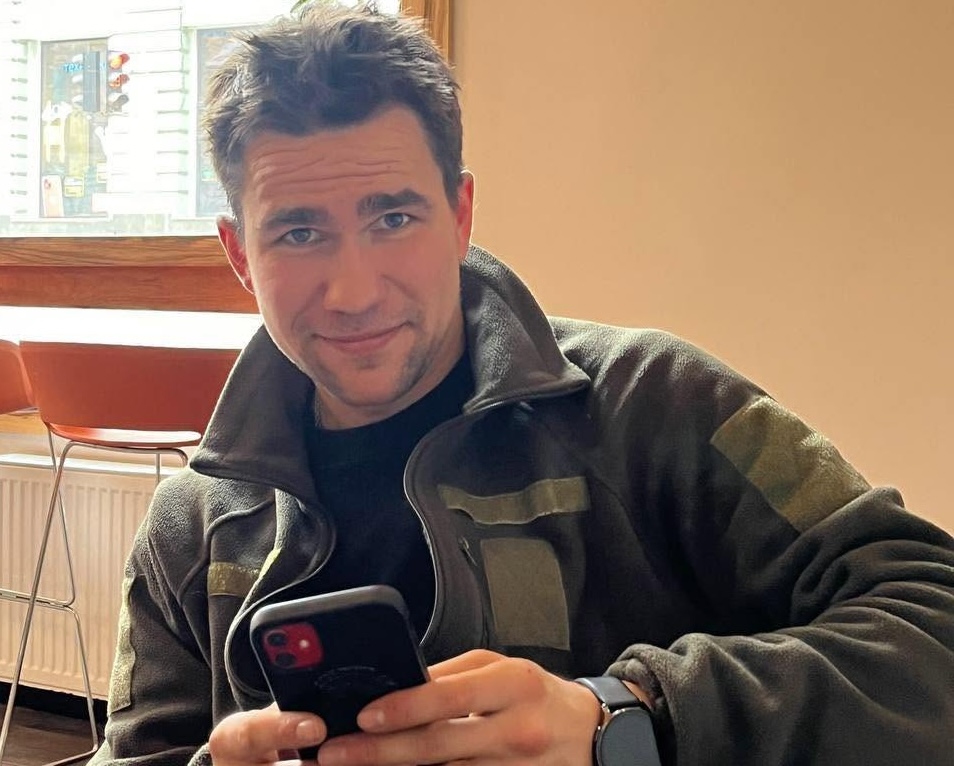
Header photo credit : Roman Zakrevsky



Leave a Reply