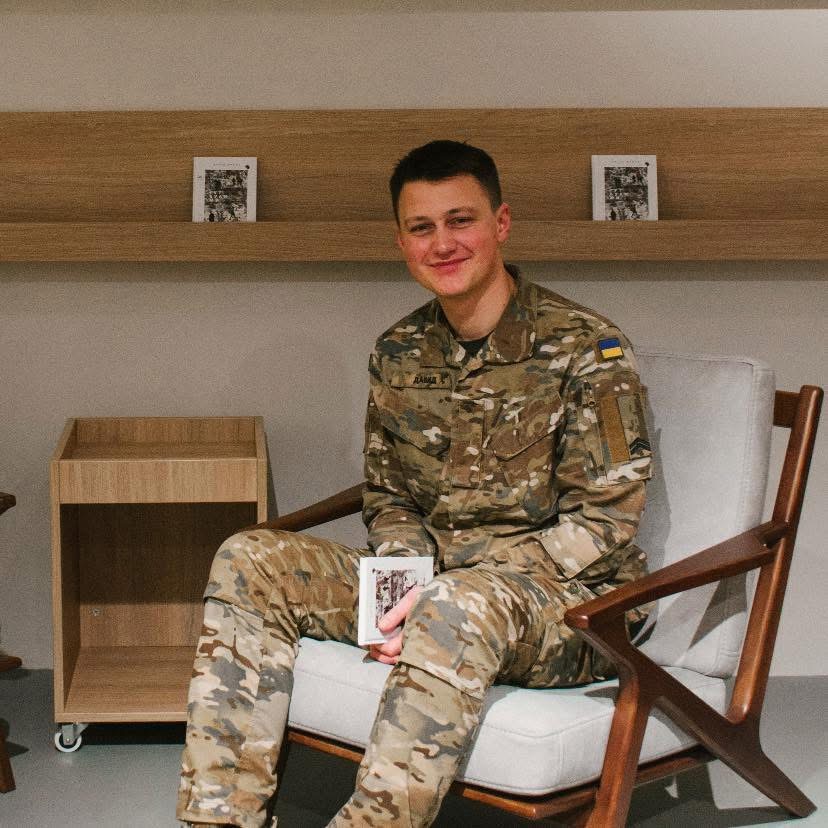
Hemingway used to say that “tomorrow’s literature will be written by young authors we know nothing about.” Not exactly. We know that Artur Dron (Артур Дронь) enlisted before reaching the legal age for conscription. We know that he joined the 125th Territorial Defense Brigade. And we know that, despite his young age, he already ranks among the most distinguished writers of his generation. Now recovering from injuries after narrowly escaping an anti-personnel mine, he agreed to this interview.
DdN – The central theme of We Were Here is love. Love and war are strange bedfellows. I don’t mean this in a sentimental way. We’re not talking about A Farewell to Arms – where a soldier falls in love with a nurse – we’re talking about Тут були ми, your book of poetry in which love is the highest form of duty.
A.D – Love and duty are very close. You don’t have to be religious to understand that killing people is wrong. Similarly, you know deep down that if someone is trying to kill the person you love, you have to defend them. The idea doesn’t have to come from Zelensky or from the State. You simply understand it.
DdN – Would you say that territory comes second?
A.D – Definitely, territory comes second. The most basic dimension of the human experience of war is love. Your first duty is to defend your loved ones. There is nothing political about it. You don’t have to think about Putin to know where your duty lies.
DdN – We met in front of a church, and you showed me religious artefacts linked to the war. Since Christian references pervade all your poems, would you call it a religious kind of love?
A.D – Love is a promise, and the promise goes like this: you may behave or misbehave in ordinary life – that’s not what matters in my eyes. Here’s what matters: I won’t abandon you in hardship. I will be there with you, and I will remember everything. You may be a sinner – I don’t care. You’re good enough for me.
DdN – This is love.
A.D – Yes.
DdN – I can only encourage readers to discover The First Letter to the Corinthians — perhaps the poem that most vividly captures what you’re describing here. What about the time-honoured injunction “love your enemy”? Does it make any sense to love your enemy – if the enemy comes and kills your loved ones?
A.D – I know for a fact that Russian wives told their soldier husbands: “Have fun with Ukrainian women. Go on, show them who we are.” It’s no use loving someone who hates you so much that they encourage rape and murder.
DdN – Instead of spreading universally, love, in that sense, draws a line – a line between what is acceptable and what is not.
A.D – The Russian invasion turned everything upside down in my world – especially in my literary world.
DdN – In what sense?
A.D – I’ll talk about the writers I used to admire. Before the full-scale invasion, I was a great admirer of Erich Maria Remarque. All literature is anti-war by nature, and for good reason. I know how horrible war is: I was wounded myself and lost comrades on a combat mission. But pacifism is a luxury we can’t afford. As you know, the Russians aren’t fighting for Crimea or for Donbas – they’re trying to reach and annihilate our very existence. It would be extremely naïve for Europe to believe it is insulated from these genocidal forces. Perhaps it is our mission, as writers, to take the opposite view and to spread an anti-Remarque message across Europe.
DdN – Is there another writer you have a bone to pick with?
A.D – When I was seventeen, The Sun Also Rises was the most important novel I’d ever read. I used to reread it every year, every autumn. Hemingway was my favourite writer. But he remained my favorite writer just until I had a war of my own. Different from his wars. War is far too romanticized in his books.
DdN – I bet he would have hated hearing that.
A.D – I bet he would. But that’s the thing, you see. He went to the front because he wanted to be a hero. We didn’t choose to go to war – and neither of us, I think, wanted to be a hero.
DdN – He chose to go to war. You didn’t.
A.D – We only choose to defend ourselves, and that makes a big difference. Hemingway, to me, is like a metaphor – something very distant from the real thing. I find it very hard to read him now. In fact, I’m finishing a book of essays. Do you want to know the title?
DdN – I do.
A.D – Hemingway Knows Nothing.
(Laughter.)
DdN – Why is that? Would you say his descriptions are tactically untrue?
A.D – War poetry isn’t about tactics – it’s about people. If you read Yaryna Chornohuz or Ihor Mitrov – two contemporary writers with vast combat experience – you’ll notice they don’t describe war tactically. The same applies to Hemingway himself. In his best military writing, war is absent. It’s nowhere to be seen.
DdN – That’s an interesting paradox.
A.D – Literature should be about human beings. Even when it’s not, it still is. The typical Ukrainian soldier isn’t a Superman – he could be forty or even fifty, he’s somewhat awkward, and he often has health problems. Today he’s in Donetsk, tomorrow he’ll be somewhere else. But he’s there. The point is to be there.
DdN – You won’t find the idea of a “just war” in Hemingway’s writings, yet it pervades your poems — and, in a broader sense, the writing of your entire generation. In a much-quoted passage from The Sling and the Pebble, published in Free World, Hemingway even portrays war as a “crime” — yet what is criminal about resisting an invader by force? And what could be absurd in trying, by any means, to halt the slaughter of one’s own people?
A.D. Exactly. Literature has grown accustomed to condemning weapons. Yet it should instead distinguish between the one who uses a weapon to attack the innocent and the one who uses it to defend themselves, their family, their people.
DdN – Even if you didn’t choose to become a “hero,” as you said, you joined the army so early that you became a wounded veteran before reaching the legal age for conscription. You’ve already told me how it happened, but could you share with our readers the story of how you came to enlist?
A.D – I made the decision to join the army sometime between the first and second day of the full-scale invasion. On the morning of February 25, I reported to the military enlistment office. But I was only able to join the army a week later — on March 2, 2022. From then until July 4, 2025, I served in the 215th Battalion of the 125th Territorial Defense Brigade. This brigade was formed in the first weeks of the full-scale war — it’s our Lviv unit. My entire service took place there, from that March day until my injury, treatment, and eventual discharge due to disability.
DdN – How did you find the time and place to write your poems?
A.D – Just as I found time to call my family via Starlink, read the news online, or simply scroll through TikTok. Of course, not every day of my service in the war was spent in a trench under fire. We had a system of combat rotations and shifts — a few days would be spent on the front line, without communication and in danger, where, naturally, there were no comforts of civilization. But between those rotations, we had rest days in nearby frontline villages, where we had Starlink, could get in touch with our loved ones, wash our clothes, rest, and take a shower. There, the conditions were quite suitable for writing. Writing things down is the final stage of creating a poem. Thinking things through, searching for the right words — you can do that almost anywhere. And then, in peace and relative safety, you sit down and write or rewrite. Though I did write some things even during combat shifts. My phone, though without connection, was always with me. Jotting down a few lines in iCloud Notes isn’t all that impossible.
DdN – This collection of poems is quite slender, and yet its impact has been enormous. You are already a highly respected author. This has a lot to do, it seems to me, with the elegant simplicity of your writing. Is simplicity something you consciously aim for ?
A.D – I don’t know if I have a goal when I write. All I know is that I never try to write the best poems. I never try to find the best word, but the only possible one.


We Were Here, by Artur Dron. Translated from the Ukrainian by Yuliya Musakovska. Edited by Hugh Roberts and Helen Vassalo, with Fiona Benson and Charlotte Shevshenko Knight. Published by Jantar Publishing (2024).
Artur’s book is available here : https://www.jantarpublishing.com/product-page/we-were-here
Le lecteur français pourra découvrir la poésie d’Artur Dron dans la traduction de Nikol Dziub aux éditions Bleu et Jaune.
Le livre d’Artur est disponible ici : https://www.editionsbleuetjaune.fr/product/nous-etions-la-artur-dron/
Photo : Artur Dron, personal archive.
Interview conducted in Lviv, June 2024.

Leave a Reply